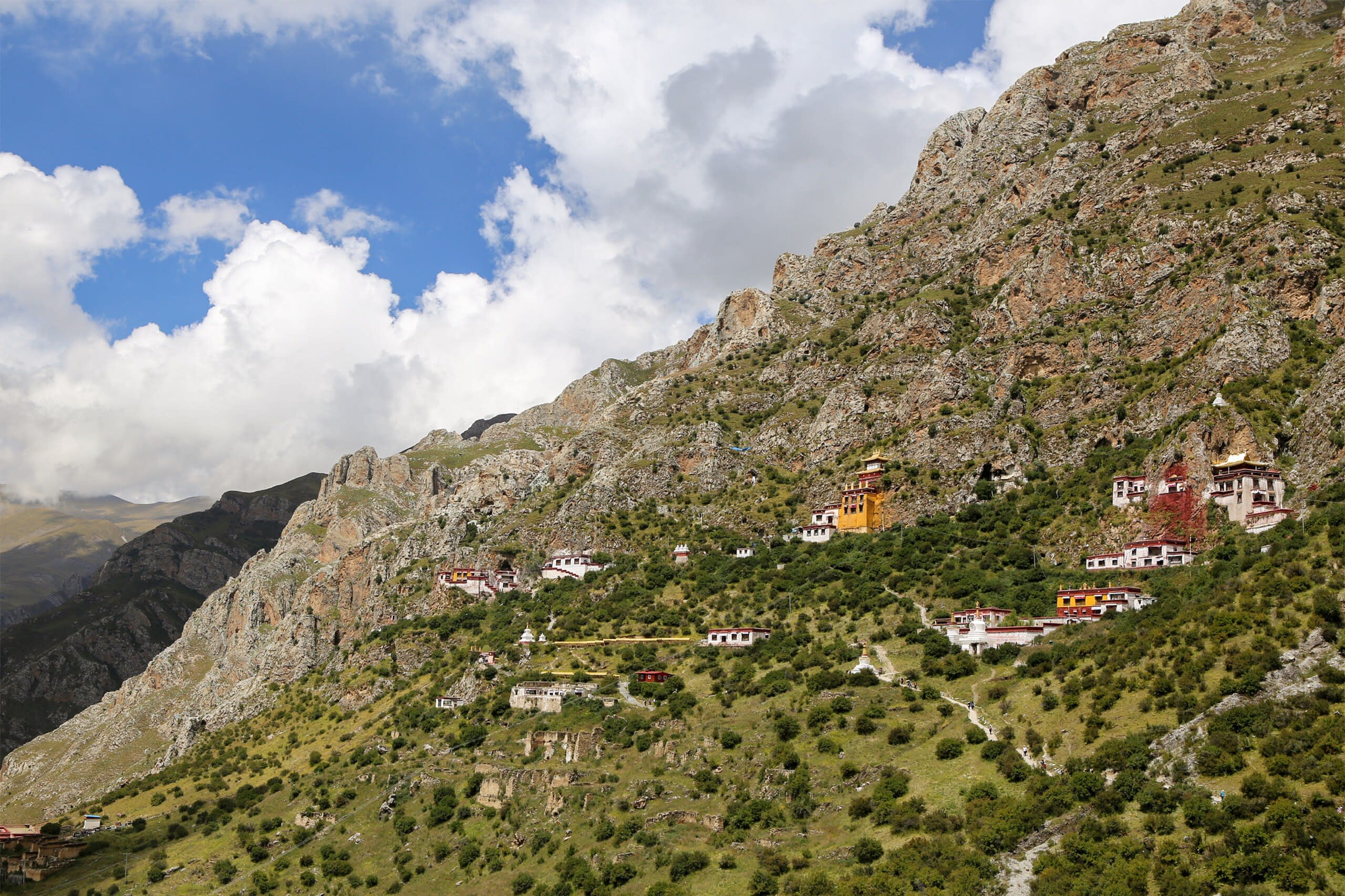
"A cliff face of 108 meditation caves where Tibet's greatest masters sat in silence for twelve centuries"
Drak Yerpa
Lhasa, Tibet, China
Drak Yerpa is a limestone cliff amphitheater northeast of Lhasa containing 108 meditation caves sanctified by twelve centuries of contemplative practice. Songtsen Gampo, Guru Rinpoche, and Atisha — three of the most important figures in Tibetan Buddhist history — all meditated in these caves. Severely damaged during the Cultural Revolution and partially rebuilt, the site remains an active pilgrimage destination and a place shaped entirely by silence and the accumulated presence of realized masters.
Weather & Best Time
Plan Your Visit
Save this site and start planning your journey.
Quick Facts
Location
Lhasa, Tibet, China
Tradition
Site Type
Coordinates
29.7428, 91.2803
Last Updated
Mar 29, 2026
Learn More
Drak Yerpa's significance rests on the extraordinary roster of masters who practiced in its caves across twelve centuries, from Tibet's first Buddhist king through the founders of its major schools.
Origin Story
The earliest Buddhist use of Drak Yerpa is attributed to King Songtsen Gampo in the seventh century. The king who unified Tibet and brought Buddhism to the plateau — through his marriages to Chinese and Nepali princesses — is said to have retreated to these caves for meditation. His Nepali consort Bhrikuti also meditated here. Their practice consecrated the site as a place where temporal power was set aside.
A century later, Guru Rinpoche chose Drak Yerpa as one of his key meditation sites during his campaign to establish Buddhism against the resistance of local spirits and competing traditions. In his cave, he performed wrathful practices to subdue the spirits and bind them as dharma protectors. The tradition holds that he left his handprint and footprint in the rock as signs of his realization.
When Atisha Dipankara arrived in Tibet from India in 1042, he was drawn to Drak Yerpa by the accumulated blessings of previous masters. He spent years here, establishing the Jampa Lhakhang and composing teachings that became foundational to the Kadampa tradition, which later evolved into the Gelug school. He reportedly declared that Drak Yerpa was comparable to the greatest meditation sites of India — a remarkable statement from a master who had seen them all.
Key Figures
King Songtsen Gampo (circa 604-650 CE)
Tibet's first great Dharma King, who unified the Tibetan plateau and introduced Buddhism. His meditation at Drak Yerpa established the site as a place of royal retreat and spiritual cultivation. His Nepali consort Bhrikuti also practiced here.
Guru Rinpoche (Padmasambhava, 8th century CE)
The Indian master who established Buddhism in Tibet against fierce opposition. His meditation cave at Drak Yerpa is the most revered at the site. He is said to have subdued local spirits and left physical signs of his realization in the rock.
Atisha Dipankara (982-1054 CE)
The great Indian scholar-saint who revitalized Buddhism in Tibet after a period of decline. He spent years at Drak Yerpa, established the Jampa Lhakhang, and composed foundational Kadampa teachings here. His residence confirmed Drak Yerpa as one of Tibet's most significant practice sites.
Spiritual Lineage
Drak Yerpa is unusual among Tibetan sacred sites in that it holds significance for multiple schools rather than being identified primarily with one. The Nyingma tradition reveres it through Guru Rinpoche. The Kadampa and Gelug traditions revere it through Atisha. The imperial period connects it to the oldest layer of Tibetan Buddhism through Songtsen Gampo. This multi-lineage significance makes Drak Yerpa a rare convergence point — a site where the major streams of Tibetan Buddhist history cross.
Know a Sacred Site We Should Include?
Help us expand our collection of sacred sites. Share your knowledge and contribute to preserving the world's spiritual heritage.