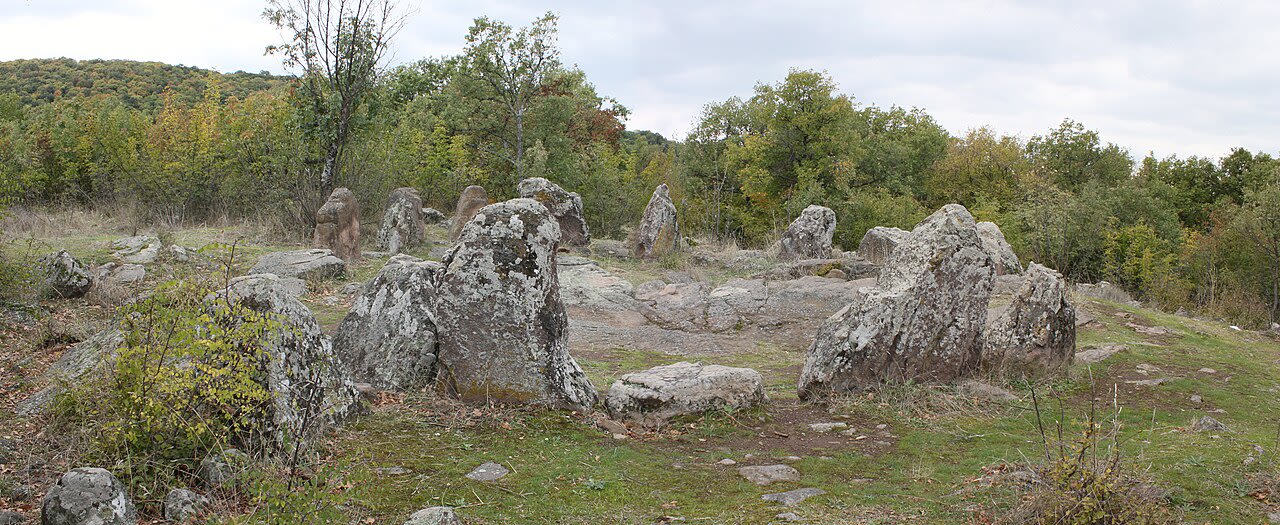
"Fifteen pyramid-shaped stones in a circle where Thracians burned offerings to gods they never named in writing"
Dolni Glavanak Cromlech
Dolni Glavanak, Haskovo, Bulgaria
The Dolni Glavanak Cromlech is the best-preserved stone circle in Bulgaria, a ring of fifteen deliberately pyramid-shaped stones arranged by Thracian communities some 2,700 years ago. Excavation revealed burnt human bone, pottery, and bronze artifacts within the enclosure, evidence of ceremonial fire and offerings whose precise meaning died with the people who performed them. The cromlech sits in a landscape dense with Thracian sacred sites in the Eastern Rhodope Mountains.
Weather & Best Time
Plan Your Visit
Save this site and start planning your journey.
Quick Facts
Location
Dolni Glavanak, Haskovo, Bulgaria
Tradition
Site Type
Coordinates
41.6819, 25.8128
Last Updated
Mar 29, 2026
Built by Thracian communities in the Iron Age, the cromlech belongs to a landscape where rock sanctuaries, tombs, and stone monuments formed a sacred geography stretching across the Eastern Rhodopes.
Origin Story
The Thracians who built the Dolni Glavanak Cromlech left no written accounts of their actions. They inhabited the Eastern Rhodope Mountains during the first millennium before the common era, part of a broader Thracian civilization that extended across much of southeastern Europe. Classical writers including Herodotus described the Thracians as a people with complex religious practices involving fire, funerary ritual, and veneration of the dead, but these accounts were written by outsiders looking in.
The cromlech's construction during the eighth through sixth centuries places it in a period of flourishing Thracian civilization. The Eastern Rhodopes during this time were home to numerous sacred sites: rock-cut sanctuaries with carved niches at places like Kovan Kaya, chambered tombs, and megalithic alignments. The cromlech, with its fifteen pyramid-shaped stones and its evidence of fire ceremonies, was one expression of a religious culture that invested heavily in marking certain landscapes as sacred.
Key Figures
Georgi Nehrizov
excavator
Bulgarian archaeologist who excavated the Dolni Glavanak Cromlech in 1998-1999, uncovering the pottery, bronze artifacts, and burnt human bone that established the site's ceremonial significance. His work brought the cromlech to scholarly attention and led to its designation as a protected cultural monument.
Spiritual Lineage
The Dolni Glavanak Cromlech belongs to a broader tradition of Thracian sacred architecture in the Eastern Rhodopes. Stone circles, rock-cut sanctuaries, and megalithic complexes throughout the region share a vocabulary of forms: carved niches, circular enclosures, hilltop placements with commanding views. The specific Thracian tribe responsible for this cromlech has not been identified, though the region was inhabited by groups including the Bessi and the Odrysae. The tradition of marking sacred space with stone arrangements in this part of southeastern Europe extends from the Iron Age into the Roman period, when Thracian practices were gradually absorbed into or displaced by Roman religion.
Know a Sacred Site We Should Include?
Help us expand our collection of sacred sites. Share your knowledge and contribute to preserving the world's spiritual heritage.