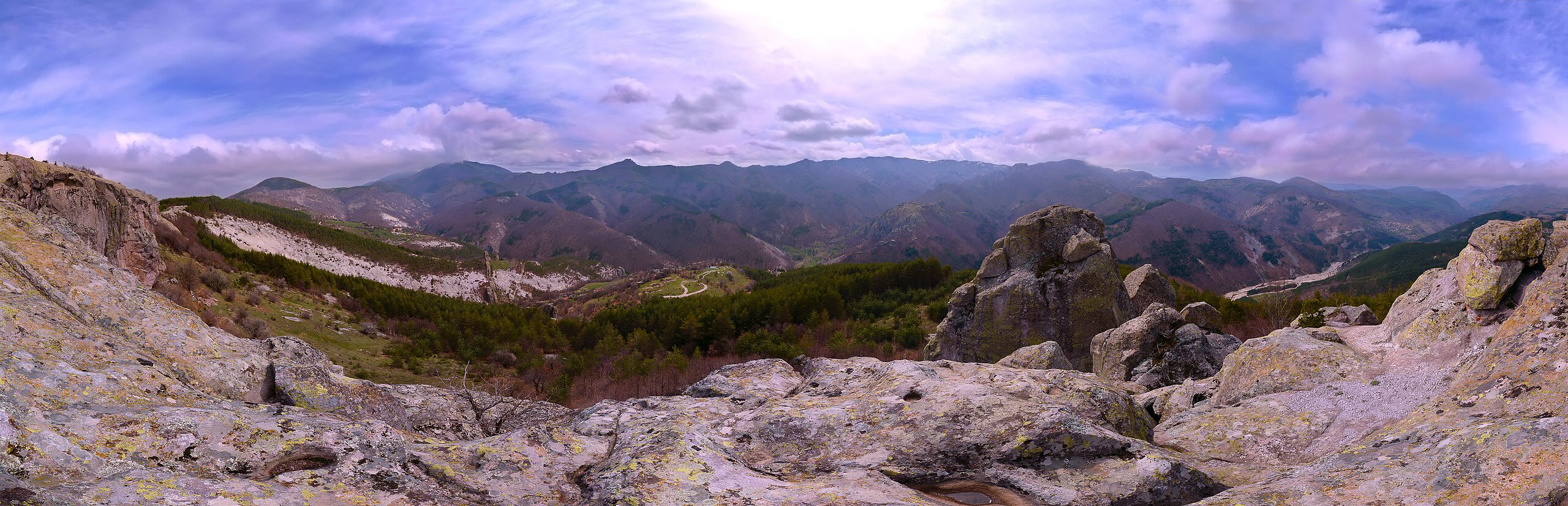
"A Thracian rock plateau carved with three hundred holes where the priest-tribe once read the sky"
Belintash
Near Mostovo (central Rhodope Mountains), Plovdiv, Bulgaria
Belintash is a bare rock plateau at 1,225 meters in the central Rhodope Mountains, where the Thracian Bessi tribe once maintained a sanctuary to Sabazios, their sky god. Approximately three hundred holes carved into the rock surface have been interpreted by some researchers as a celestial map depicting major constellations. A silver votive plate found here confirms ritual offerings. Today visitors write wishes on paper and tuck them into the roots of twisted trees growing from crevices at the summit, an unplanned practice that suggests the place continues to compel.
Weather & Best Time
Plan Your Visit
Save this site and start planning your journey.
Quick Facts
Location
Near Mostovo (central Rhodope Mountains), Plovdiv, Bulgaria
Tradition
Site Type
Coordinates
41.8500, 24.9683
Last Updated
Mar 29, 2026
A sanctuary of the Bessi, the Thracian priest-tribe whom Herodotus described as interpreters of the oracle of Dionysos in the Rhodope Mountains.
Origin Story
No textual origin story survives from the Thracian period. The Bessi, who used this sanctuary, were described by both Herodotus and the geographer Strabo as a priestly people inhabiting the Rhodope Mountains. Herodotus specifically identifies them as interpreters of the oracle of Dionysos, a deity whom modern scholars associate with the Thracian god Sabazios, a sky deity connected to fertility, sovereignty, and the horseman archetype. The Bessi were not merely a tribe but a priestly caste whose role in Thracian society was religious interpretation and oracular prophecy. Their use of Belintash as a sanctuary suggests the plateau served some function in this oracular practice, though the specific nature of that function has not been recovered.
The approximately three hundred carved holes in the rock surface have generated the most sustained interpretive effort. Some researchers see in their arrangement the constellations Orion, Ursa Major, Ursa Minor, and Leo, arguing that the Thracians used the plateau as a celestial observatory. If this interpretation is correct, it would connect the sanctuary to a tradition of astronomical observation found at sacred sites across the ancient world. Mainstream archaeology, however, treats this interpretation as unproven.
Key Figures
The Bessi
priestly tribe and sanctuary custodians
A Thracian tribe or priestly caste inhabiting the central Rhodope Mountains, described by Herodotus as interpreters of the oracle of Dionysos. Known throughout the ancient world for their religious role, the Bessi maintained sanctuaries in the Rhodopes where they practiced divination and ritual worship. Their association with Belintash connects the plateau to the broader tradition of Thracian oracular practice.
Herodotus
ancient chronicler
The fifth-century Greek historian who described the Bessi as priestly interpreters of an oracle in the Rhodope Mountains. His account is the most significant ancient literary reference connecting the Bessi to the religious landscape of the Rhodopes.
Spiritual Lineage
Belintash belongs to the Thracian tradition of rock sanctuaries in the Rhodope Mountains, a tradition that produced numerous sacred sites including Kovan Kaya, Tatul, and Perperikon. These sanctuaries share common features: elevated positions, rock-cut features, and evidence of fire-related ritual. The Bessi's oracular tradition connects to broader patterns of prophetic practice in the ancient Mediterranean, from Delphi to Dodona. The plateau's popular identification as part of a sacred triad with Krastova Gora and Karadjov Kamak, while not archaeologically verified, reflects the region's density of sacred sites.
Know a Sacred Site We Should Include?
Help us expand our collection of sacred sites. Share your knowledge and contribute to preserving the world's spiritual heritage.