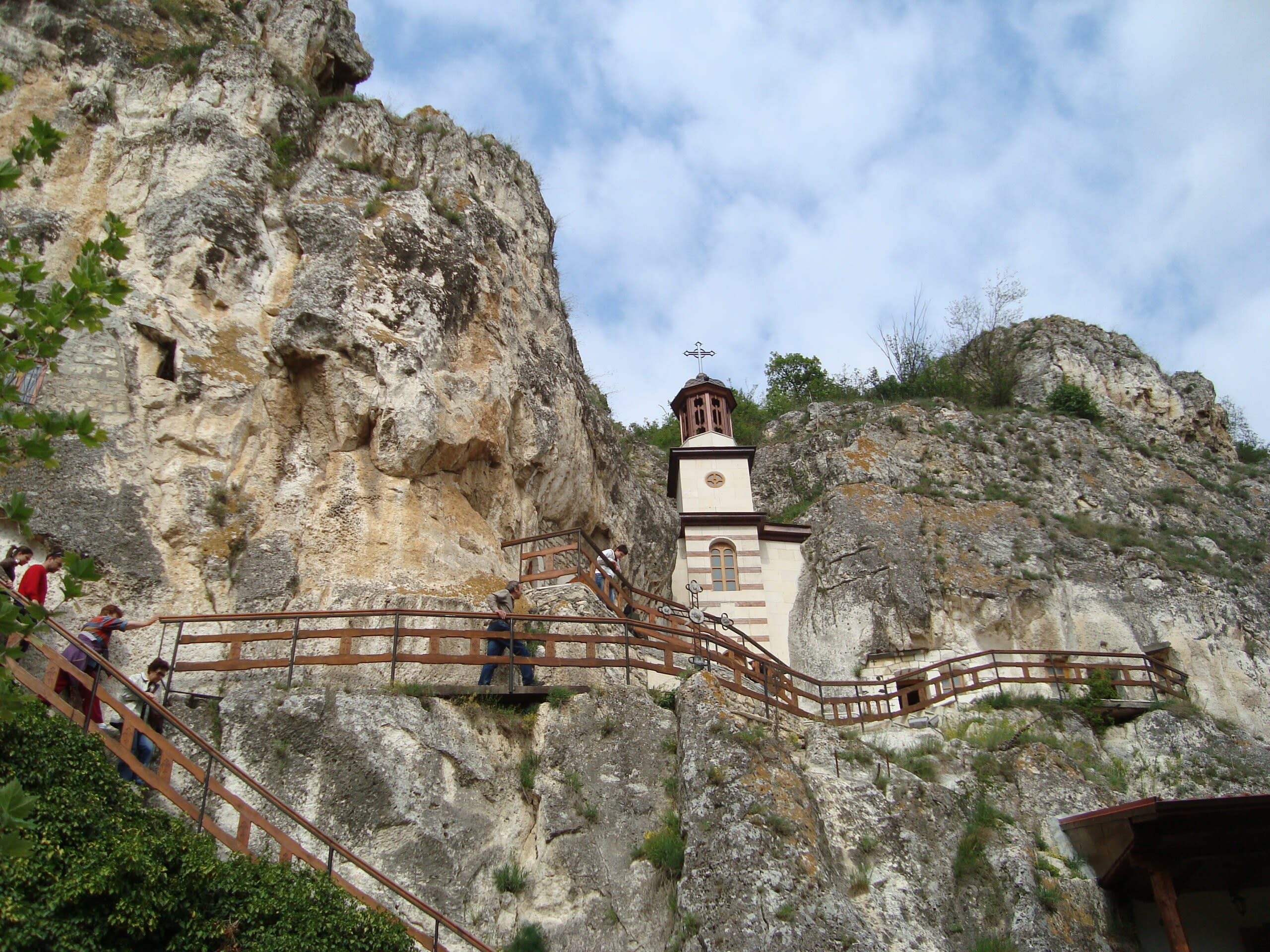
"Bulgaria's only active cave monastery, carved from limestone above a flowing river"
Basarbovo Monastery
Basarbovo, Ruse, Bulgaria
Basarbovo Monastery is carved into limestone cliffs above the Rusenski Lom river in northeastern Bulgaria. It is the only active cave monastery in the country. The rock-hewn church, barely large enough for a dozen worshippers, holds centuries of monastic prayer in a space where the boundary between human construction and natural stone dissolves. A holy spring, dug by a monk named Dimitrii, draws pilgrims seeking healing. The memory of St. Dimitar Basarbovski, a shepherd-saint whose relics stopped a plague in Bucharest, permeates every surface.
Weather & Best Time
Plan Your Visit
Save this site and start planning your journey.
Quick Facts
Location
Basarbovo, Ruse, Bulgaria
Tradition
Site Type
Year Built
Second Bulgarian Empire, 15th century, 1685, 1768-1774, 1937, 1978
Coordinates
43.7667, 25.9649
Last Updated
Mar 29, 2026
Learn More
Basarbovo Monastery was established during the Second Bulgarian Empire by monks who carved their community from limestone cliffs above the Rusenski Lom. It first appears in a 1431 Ottoman tax register. The monastery is inseparable from the story of St. Dimitar Basarbovski, a shepherd-saint born around 1685, whose incorrupt relics were transferred to Bucharest during the Russo-Turkish War.
Origin Story
The monks who first carved into these cliffs chose a tradition as old as the desert fathers: withdrawal from the world into the raw material of creation. In the Rusenski Lom valley, that material was limestone, soft enough to work with iron tools, hard enough to endure. They hollowed out cells, corridors, and churches from the living rock, creating monasteries that were part of the cliff itself.
Basarbovo emerged from this tradition at a date no one can pin precisely. By the time it appears in the 1431 Ottoman tax register, it is already established. But the monastery's spiritual identity crystallized around a man born centuries later. Dimitar was born around 1685 in the village of Basarbovo. He lived as a shepherd, tending his flock while maintaining an interior life of prayer so deep that his contemporaries recognized him as holy. After death, his body was found incorrupt. When Russian soldiers transferred the relics to Bucharest during the Russo-Turkish War, a plague that had been devastating the city reportedly ceased. The relics remain in Bucharest's Church of St. Constantine and Elena, but the saint's spiritual home is the cliff above the river.
Key Figures
St. Dimitar Basarbovski
Patron saint
Father Hrisant
Reviver
Monk Dimitrii
Well-digger
Spiritual Lineage
Basarbovo belongs to the medieval Bulgarian tradition of rock-hewn monasticism that flourished in the Rusenski Lom valley. This tradition shares architectural and spiritual kinship with the famous Ivanovo Rock-Hewn Churches (UNESCO World Heritage Site) ten kilometers away. The broader tradition of cave monasticism connects Basarbovo to similar communities across the Balkans, Cappadocia, and the early Christian desert tradition. As the only active cave monastery in Bulgaria, Basarbovo is the living end of a lineage that once included many communities.
Know a Sacred Site We Should Include?
Help us expand our collection of sacred sites. Share your knowledge and contribute to preserving the world's spiritual heritage.