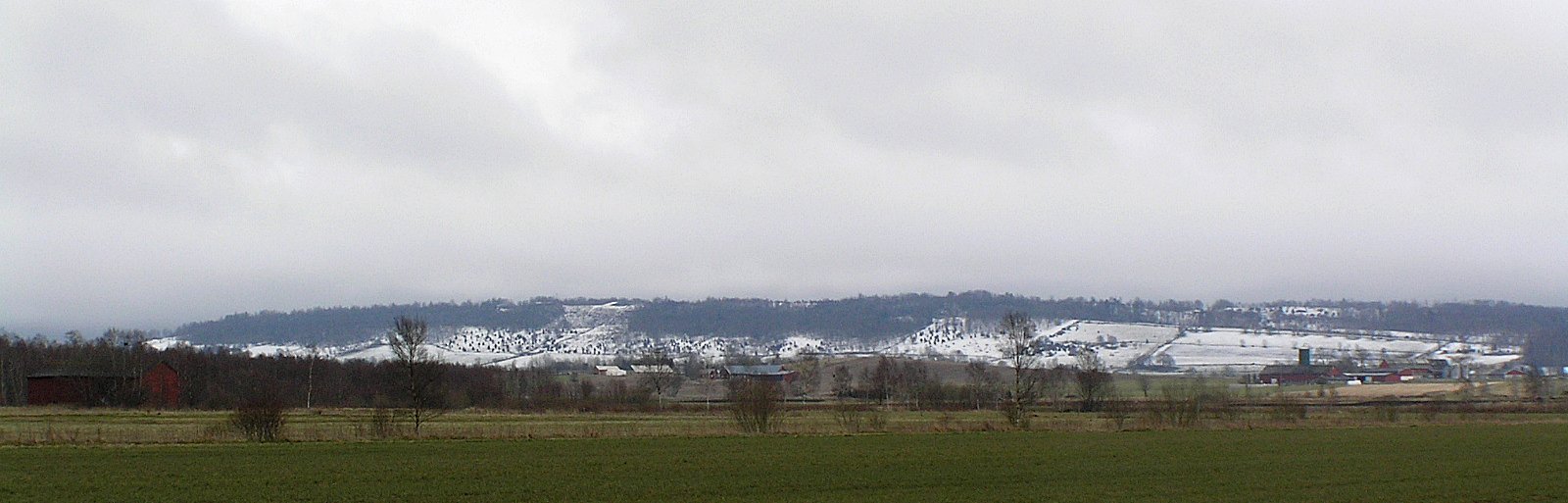
"A table mountain hiding sleeping knights in golden armor and one of Sweden's most exquisite gold treasures"
Ålleberg
Falköpings kommun, Västra Götalands län, Sweden
Alleberg rises sharply from the Falbygden plain in western Sweden, a table mountain shaped by 150 million years of geology and inhabited, according to legend, by twelve sleeping knights in golden armor who wait to save Sweden in its hour of greatest need. On its slopes, a Migration Period gold collar of extraordinary craftsmanship was discovered, one of only three such objects known from Iron Age Scandinavia, now displayed in the Gold Room at the Swedish History Museum.
Weather & Best Time
Plan Your Visit
Save this site and start planning your journey.
Quick Facts
Location
Falköpings kommun, Västra Götalands län, Sweden
Site Type
Coordinates
58.1333, 13.6000
Last Updated
Feb 17, 2026
Learn More
A table mountain in the Falbygden landscape, connected to Migration Period elite culture through a gold collar and to Swedish folklore through the legend of twelve sleeping knights.
Origin Story
The legend of the Knights of Alleberg anchors the mountain in a specific historical moment: the Battle of Asle in 1389, fought between Queen Margareta and Albrekt of Mecklenburg for control of Sweden. According to the legend, twelve knights who fell in the battle entered the mountain and remain there, sleeping in golden armor, waiting for a future war when they will emerge to save Sweden.
Variants of the legend elaborate the story. In one version, Queen Margareta herself watched from the mountain as twelve gold-helmeted riders mysteriously appeared on the battlefield, turning defeat into victory, then vanished back into the mountain. In folk tales, farmers stumble through hidden openings into the mountain's interior, finding the sleeping knights surrounded by golden treasure. Those who take gold discover it turns to sand when they leave the mountain, a motif common in Scandinavian folklore about encounters with supernatural wealth.
The gold collar found on the mountain's slopes, dating to the fifth century AD, predates the legend by nearly a millennium but resonates with it. Whoever deposited this exquisite gold object on the mountain, whether as an offering, as an act of concealment, or for other reasons, connected Alleberg to gold and to the sacred or ceremonial power that gold represented in Migration Period Scandinavia.
Key Figures
Queen Margareta
Danish-Norwegian-Swedish queen whose forces fought at the Battle of Asle, central figure in the sleeping knights legend
Spiritual Lineage
Alleberg connects to the broader tradition of sacred mountains in Scandinavian culture, where prominent peaks and plateaus were understood as dwelling places of supernatural beings. The sleeping warriors motif appears across European folklore, from King Arthur in Britain to Frederick Barbarossa in Germany. The gold collar connects the mountain to the elite material culture of Migration Period Scandinavia, a time of profound social and cultural transformation in northern Europe.
Know a Sacred Site We Should Include?
Help us expand our collection of sacred sites. Share your knowledge and contribute to preserving the world's spiritual heritage.